“Family quarrels are bitter things. They don’t go according to any rules. They’re not like aches or wounds, they’re more like splits in the skin that won’t heal because there’s not enough material.”
F. Scott Fitzgerald
“Happy or unhappy, families are all mysterious. We have only to imagine how differently we would be described – and will be, after our deaths – by each of the family members who believe they know us.”
Gloria Steinem
The tension was wrapped tight in the air of their mother’s kitchen, like a rubber band about to snap. It had started when Miracle had come home that afternoon, immediately throwing her bags down in her room upstairs and taking charge. Now, Mike stood with her and Matt as she talked on the phone to the florist in charge of making flower arrangements for Dad’s funeral. He watched as she said, “Yes, perhaps some daisies or some sunflowers. I think I heard somewhere that sunflowers symbolize joy, and I think my siblings and I want to celebrate his life during this event.” She tapped her pen absently on the yellow notepad in front of her on the white countertop. Mike wanted to take it and throw it on the floor.
He took her hand, stilling it before she could put the pen back to paper. “Stop tapping it like that. And seriously, you sound anxious. Calm down, you’re just ordering flowers for Cindy. It’s not that hard.”
Miracle pulled the phone away from her ear, before hissing, “Not that hard? Do you think I want to be doing this shit? No. But I always end up doing this shit. Not you, not Matt.”
Mike scoffed. Matt looked taken aback, saying, “Don’t drag me into this, Mira. Stop treating me like a dumbass. You didn’t even ask me about the flowers.”
“You didn’t offer!” Miracle took on a face of exasperation. “You’re lucky the florist just put me on hold.”
Mike laughed bitterly. “I’m lucky? Really? Because I’m the one who had to sit here and watch Dad wither away while you two were at college, I’m the one who had to help Mom pick up the slack these past year. You two were in the middle of Bumfuck Nowhere apparently ‘getting an education,’ up until yesterday. I’ve been here. I’ve been doing shit. Y’all can fuck off.”
Miracle looked like she had been slapped. Matt’s mouth turned into a thin line of displeasure. He didn’t care. He didn’t look back as he walked outside to play some basketball alone. He didn’t see how Matt slunk back upstairs, drowning his thoughts in rap music blaring out of his headphones. He didn’t see how Miracle clicked off her phone, and then went to sit down at the dinner table, head in her hands. When Mom asked how the arrangements were going that night, none of the siblings spoke up, letting the stony, stormy gazes and the silence speak for itself.
Miracle Gardiner always felt the pressure pushing down on her, like a weight above her head, edging closer and closer until it settled on her skull and would eventually crush her beneath it. She would never be able to escape it, not fully at least. Her name made sure of that. Miracle was, in fact, a miracle–a child who wasn’t supposed to survive the act of childbirth. Her grandmother loved to tell the story of how after they had cut her out of her unconscious mother on that operating table, the team of doctors rushed baby Miracle into the hallway, and only stopped to let her grandmother see her when the nurse said, “Stop! This is the grandmother!” Miracle always shook her head at that part. Typical Gigi, always centering herself in other people’s narratives.
After that brief moment in the hall, she was then placed in the hospital’s Newborn Intensive Care Unit, better known as a “NICU,” where she spent the better part of three months in an incubator (yes, like the things you put chicken eggs into as you wait for them to hatch; Miracle proudly told her kindergarten teacher that she was in a similar machine after she was born when the class began their animal unit and they observed the eggs laying in the incubators). She only weighed two pounds and two ounces; her skin was a bright, angry red. Her father liked to tell her a story every so often of how he could slide his wedding ring up her arm all the way to her shoulder. People came by constantly; praying over her, crying over her, cradling the glass as if she could feel their touch. One of Grandpa’s relatives taped a guardian angel to the machine. Doctors constantly monitored her progress: when she gained weight, lost weight, whether she was developing normally.
When Miracle was allowed to come home months after her birth, life settled into a sort of new normal. She had gained some weight, her skin tone was less tomato and more the color of mayonnaise. Her mother and grandmother dressed her up in cute jumpers and dresses, but no one was allowed to come in the house. Instead, Gigi’s neighbors who wanted to see the family’s new addition had to stand outside the house’s large bay window in the kitchen, and Miracle, small and adorable, was hoisted up in the air for everyone to see. It was like she was the second coming of Christ or something, whenever her grandmother got in those moods when she met one of Miracle’s friends, or it was a family holiday and she had a bit to drink, and decided to tell everyone about Miracle’s premature birth, how she and her mother were not supposed to survive, and sometimes her dad would chime in with the ring anecdote, or her grandpa would talk about how he would sneak her whipped cream after she moved home from the hospital, putting a dab on her lips, and watching as she “adorably” licked it away.
All these stories did was add to the invisible pressure that had grown over the years. Overall, Miracle had grown up without disabilities, physically or mentally. She had to go to Early Childhood when she was three and four, just to make sure she had developed as well as her peers. At the same time, she began physical and occupational therapy that continued until she was eight years old. But she graduated from all of that in due time. That was another thing she was praised for. She had done what some of her premature peers couldn’t: Become a “normal” kid. Now that she was older, and realized the context behind that, it made her hate being called a “miracle” even more. Screw adhering to society’s ableist bullshit.
But then for her young self, it all changed again. She was subjected to a reading test in Kindergarten after she had corrected a substitute teacher about the spelling of her classmate’s name on the whiteboard. By the time she was in first grade, Miracle could read at an eighth grade level. The teacher had to send her to the second grade classroom to get different books from her classmates in the mornings for take-home reading assignments. Suddenly, Miracle just wasn’t “normal.” She was “gifted.” That’s where the pressure began to weigh on her.
In actuality, she was scared to go to the other classroom to get different books. Her teacher, Mrs. Fiske, said all she had to do was slip in and grab one and she wouldn’t be disturbed. But she sometimes felt the older kids’ eyes on her as she walked past their desks to the back of the room. She was overwhelmed by the feeling of being watched by strangers while she was attempting to pick a book. Books were calming to her and their staring made it profoundly uncomfortable. So, some days, she wouldn’t go at all to the second grade classroom. She would stay in her bubble, surrounded by the classmates she knew, the books that were already familiar. She read the same Magic Tree House book, “Night of the Ninjas,” about three times that year. Her mother called her out on it at least once, saying, “You’ve already read this to me before. Aren’t you able to go and pick out different books?” All Miracle could recall from that memory was her throat going dry before she stumbled through a lame excuse.
The next year, she had a dance recital at the auditorium in the college town next to theirs, where she was dressed as corn–like corn fresh off the farm. It was a green jumpsuit number, with yellow fabric and gold glitter emblazoned on the front to signify the kernels. Girls from the other class got to be cows. To this day, she wished she had been a cow instead, but that wasn’t the point. The point was that before she went on, her throat again went dry, and she felt like she couldn’t breathe. She was eight years old, dressed as fucking corn, hyperventilating about going onstage for all the parents and siblings and grandparents and dancing semi-offbeat. They had to get her mother to calm her down, and to do that, her mother had to tell her, “If you go onstage, you won’t have to be in a dance class ever again.” So, Miracle went onstage and did her little dance, and that was the end of her dance career.
To be fair, she didn’t really remember it, the dance or the panic attack. But her mother did, and she thought her own body did, so much so that it went out of the way to go block that memory out. It wasn’t until later in life that she had a name for that pressure, that scared feeling over things other people didn’t have over dancing on stage, getting books from a different classroom, raising her hand in class to ask for help. It was anxiety, defined as “a feeling of fear, dread, and uneasiness,” according to the dictionary.
Sure, everyone gets anxiety over certain things–public speaking, perhaps. But Miracle knew that the edge of dread had plagued her since she was young over the simplest things, and it had only gotten worse as she got older. When she started college, she was scared to go to the cafeteria alone. She struggled connecting with her peers. Home was a minefield–Eddie, her stepfather had left her mom, Dad had gotten so sick, he was admitted to the hospital, and then diagnosed with cancer. But the kicker was that he didn’t tell her that he wasn’t feeling well right away. He hadn’t “wanted her to worry,” and that supremely pissed her off. She couldn’t help her feelings.
So after all of that, Miracle had turned further inward. She hunkered down at her desk and chipped away at her schoolwork, determined to make it perfect. She ate in her room often, or sometimes not at all, avoiding the cafeteria where everyone would notice that she was sitting alone. She hated eating alone in a room full of people. She was always skinny, but she lost weight, becoming a spindly little thing.
When she came home for break, people commented on it and not in a good way. Her parents equated it to the stress of everything going on at home. And sure, it was partly that the stress of everything at home ate at her constantly right now, and she felt that pressure weighing on her to be perfect so her parents didn’t have to worry about her, but honestly? It was that anxiety that made her throat close up when she thought about venturing into the cafeteria alone. That was the biggest factor of why she lost weight, and she thought if she expressed that notion to her parents, they would laugh at her. Food and her schoolwork were the only things that she had control over.
When she came home from school that summer, everything had thrown her off-balance. Her dad wasn’t well. She had gone over to his house one day over spring break, and she had peered into his bedroom and saw a person she didn’t recognize at first in his bed. He was thin, much too thin, and he was bald. It hadn’t registered to her that it was her father, and that thought disarmed her. When she left his house and drove to the store, she had parked in the parking lot and cried.
Her mom was different too after Eddie left. She saw that her mom was unmoored, aimless. She had to pick up a second job to cover the bills and was home less and less, but that wasn’t all. She went out drinking, partying until the early hours of the morning. She went out on dates with men that left a bad taste in her mouth as they shook her hand and introduced themselves. She saw how these men caused her mom even more pain as they inevitably screwed up in some way. She worried as her mom walked home from the bars alone, clearly intoxicated.
And when she voiced these opinions to her mom, they began to fight bitterly. Their relationship must have frayed and repaired itself a thousand different times that summer–the anger boiling over to be replaced by a fragile truce and then back again. She couldn’t abandon her mom. She needed her help, especially now. Someone had to help clean the house, someone had to drive Matt and Mike to sports practices, someone had to pick up the groceries, and that someone just happened to be Miracle.
Eventually, her parents got her put on anti-anxiety and depression meds, something called Citalopram. But even that was because they felt like “she wasn’t pulling her weight,” that she was unnecessarily angry. And she was angry. Miracle always had to be the one to step up. She was the oldest, the one her parents looked to when they couldn’t. So, it was no surprise that the family was again looking to her in this moment of turmoil. Dad was gone and Cindy couldn’t handle his arrangements by herself, and so, Miracle, Matt, and Mike had to go help their stepmother figure out how to bury their dad, and their mom was supposed to be coming too.
On this particular morning, Miracle sat up in bed, looked at her clock on the bedside table, and distinctly felt like this might be the day where that invisible pressure swallowed her whole. But she couldn’t push it aside, curl back into a ball, and sleep the day away. People were counting on her as always–the “miracle” child, so smart, so level headed, so willing to always lend a helping hand. Therefore, it should have been no surprise to anyone when Miracle Gardiner threw back her covers and went to go shower.
Unlike his older sister, middle child Matthew “Matt” Gardiner floated through life in a sense. Weed helped with that sensation often. When he first tried the miracle of marijuana, he was seventeen, and he had been with Ty, Connor, and Ben, his best friends, and he liked how it slowed his brain down into a type of fluid calm. Finally, he could focus! The focus thing was not new–he had been diagnosed with Attention Deficit Disorder by the time he was in second grade. He couldn’t get any schoolwork done, he was often distracted by the things out in the hall–the whispers of his classmates, the shuffling of footsteps walking by.
The prescription medication he was put on helped a lot with his focus and concentration as well, but it turned him into a sort of “zombie.” There was no better way to put it, honestly. He was able to sit down and do just about anything in a normal amount of time, but he struggled to eat. He struggled to get sleep. And most of all, he hated how his grandparents began to treat him after his diagnosis.
Personally, Matt thought the cards were stacked against him since birth. Unlike his older sister Mira, he was born fairly normally. The only issue was that he was a large, fat baby, and the doctors struggled to get him out. He apparently even broke the vacuum suction thing they brought in at first to pull him out of his mom. But, besides that minor mishap, he was healthy. The problem for his grandparents, especially Gigi, he thought was that he looked like his mother.
The tension with Gigi and Mom had begun a couple years before Matt was born. In fact, it started with Mira. Mom and Dad were young when she got pregnant with his older sister. Dad was almost done with college, Mom almost 20. Clearly, the two were not married. Grandma was pissed–her son’s charmed prospects burned to the ground. Grandpa even went so far as to tell Dad that he didn’t have to marry Mom, that she would spend all his money (not true, in fact; Dad often caused his own money troubles). But with Mira, their grandparents were suddenly cast as the heroes of their sweet, sweet granddaughter born too early, who looked a lot like their son with her dirty blonde hair and nose. The only giveaway that she was related to their mom was the green tint in her eyes.
Meanwhile, Matt inherited almost everything from their mother: her nose, her facial sculpting, her dark hair. On the flip side, the only giveaway that he was related to their dad was the blue tint in his eyes. While Mira was pale like a ghost, his skin was apt to a slight tan, even in the coldest of temperatures. Same thing went for their younger brother Mike. Mike’s skin was a in-between shade, not quite as milky, not quite as sandy. But, he too, took after their father, even more exactly. People called him “Dad’s Mini-Me,” even down to the eye color.
Even after their parents divorced, Matt still felt like Gigi held a slight grudge against their mother, and all of those who resembled her. She would often buy Mike and Mira new clothes, and not bring him anything when she came to visit, or picked them up from school, or took them out to dinner. She became a constant presence in that first year during the divorce–when Dad had to go to work, Gigi stepped in. They saw Mom less frequently.
Later on, as Matt thought more and more about it, he thought about how maybe Gigi was trying to buy back Mira’s love, as well as placate a young Mike. Gigi would talk occasionally about how their mother was mentally ill: how she was “crazy,” how she gave up on her kids. After enduring several of these conversations, nine-year-old Mira would explode in anger and defend their mother, who wasn’t there to defend herself. Five-year-old Matt and three-year-old Mike couldn’t really say anything about it, so, yeah, it was left to Mira. And he did feel bad about it, now that he was older. But he thought that’s where it started with Gigi buying Mira things–wanting her love back, even in the tiniest way.
Meanwhile, Mike was young, without his mom during some of his most formative years. So, in a way, it did make sense that she was always doting on little Mike, trying to maybe fill the gaps that Mom and Dad couldn’t during that time. But he never could figure out the key questions that ate at him: What about him? Why did they forget about him? Ignore him?
After his diagnosis, he began to see more of the big picture with his grandparents, and even his own father. They treated him like he was an idiot, unable to focus. He got into arguments with them during family vacations about taking his prescriptions, even though he should have been allowed to be free, energetic. He wasn’t in class, so let him be, right? Wrong. Fits were thrown, arguments had. Sometimes he won. Sometimes he didn’t.
Eventually, he embraced the moniker that his grandparents and dad bestowed upon him as the days, weeks, years went by. Why try to meet expectations that no one thinks you can meet anyway? Might as well coast. Homework? Something to be done occasionally–usually in cases of emergency (the emergencies amounting to getting his car keys taken away, or his phone or game systems confiscated). Work? Often, to get out of the house. Ditto with seeing friends. When his dad inevitably complained about his grades, it only made him rail against him harder. Dad didn’t want to talk to him about anything else. Every other conversation they had was stilted, awkward.
This tension with Dad got worse after his diagnosis. He was home all the time. He couldn’t work. His world was basically made up of three buildings: the hospital, the house, the pharmacy. And guess who had to take him around when his stepmom couldn’t? That’s right! He did. And Dad was often crabby, critical of his driving, the wait times, the fact that he occasionally messed up the directions. It made him angry. It made him hate his own father.
When his mom and sister found out he was dabbling in weed and shit like that, it was by accident one late night. He took two hits of a dab pen, ate a whole pizza, ate one of those cookie pie dessert things, got dizzy, and then rushed upstairs from the basement to puke. It was two AM, and his sister and mother were concerned, and obviously, a little annoyed. They were surprised to find out Mike already knew, and didn’t say anything the next morning. They didn’t understand their brother bond. At least they agreed to keep quiet about it from Dad, the former cop who would probably go apeshit and then keel over and die–even Mira kept quiet, with her habitual big mouth.
Dad wasn’t even supportive of him going to college for Film Studies. He was literally the last one he told because of his anxiety over his reaction. Mira had to sit down with Dad and discuss his reasons for going into that area of study. For a while, Dad wasn’t even sure he could go to college, and that pissed him off even more. He was only placated when Matt found a college in Illinois with extensive contacts and connections to the local Chicago TV markets. It probably also helped that it was a Christian college, similar to the private institution Miracle attended. Less reason to be worried about Matt, right, when he was encapsulated in The Bubble of Jesus.
Not going to lie though, The Bubble of Jesus wasn’t as bad as he made it out to be. Mira told him that he was going to struggle a bit like she did in the beginning, but honestly? It was a breeze. The Prozac and the upped dosage of the ADD medication that he was prescribed really did wonders, once he was in an environment where he wasn’t pressured, wasn’t railed on for “being dumb.” He focused on his art, he focused on his games, and he focused on his skateboarding. He was creatively invigorated. Everyone (especially Gramps and Gigi) seemed happy to know that he was pulling solid B’s in every class–surprised even. But perhaps the best thing was that when his dad called, he wasn’t obligated to pick up the phone.
So, on this particular morning for Matt, he had to admit that he was a bit ashamed. He was back in his childhood bed, his room decorated with the Kanye West and Mac Miller posters he pinned up in high school. He couldn’t sleep a wink that night, and ended up staring at the ceiling. What would it have been like if his relationship with his dad and his grandparents were different? He heard his sister pad down the hall to the bathroom and start up the shower. Picking up his cell phone and looking at the time, Matt groaned, and rolled over in an attempt to possibly, finally fall asleep. It should have surprised no one that Matthew Gardiner was slow to rise in the morning.
Unlike his older brother and sister, Michael Gardiner (though he preferred Mike to his friends and family) didn’t really remember the dissolution of his parents’ marriage. He was young, really young. To be honest, he wasn’t even supposed to have been born. He was one of those “oopsies,” those “mistake babies.” His dad didn’t want him at first, but his mother did. So, back and forth ensued. And after those fateful nine months, Mike was born, but the joy of a new addition to the family didn’t last long. The illusion faded. Mom was unhappy, Dad was messing around with Cindy again. But, as he said, he couldn’t remember much about the actual divorce, just the narrative that had been repeated years and years after the fact.
The thing that really affected him, he guessed, was the systemic change that rippled out from his parents’ conscious uncoupling. His mom wasn’t around for like a solid year and a half because she was getting treatment for her depression, and then had to move in with their uncle, who lived in Madison. His dad was working all the time, so Gigi was taking care of him and his siblings most days.
And that was just the beginning of it all. After the divorce was finalized, he was forced to split time between two households. Mom usually got Monday and Tuesday, Dad got Wednesday and Thursday, and then they would switch off weekends. Back then, Mom moved a town over, so they had to commute about 20 minutes to her new house with her (then) new boyfriend, Eddie and his kids. Dad was still in the old house. He remembered how the elementary school counselor checked in with him about the “transition” of everything. She agreed with him that it was a lot.
“A lot” was probably the most basic definition of what was going on in Mike’s head. He had no time to slow down and think. He was always on the move, shifting from place to place–Gigi and Gramps’, Mom and Eddie’s, Dad’s, school, junior baseball league. He buried his emotions deep down because he was never in one place long enough to sit down and really express them. The counselor thought he should talk to an actual therapist, but his dad thought he was fine, so he didn’t go.
Now that he thought about it, he probably did need therapy back then. It was too late for that now. He was embroiled in what his sister labeled “typical toxic masculinity bullshit.” But she didn’t understand how the anger built up, crackling underneath his skin. She didn’t understand how when he finally got so angry that it erupted from him like a volcano, and he couldn’t contain the blast. Occasionally, he also realized that sometimes, he didn’t even register the other people around him when he became a rage monster. “Too bad, so sad,” right? Dad was dead and he had fucked him up. Him and Eddie both, to be honest.
He remembered when his dad was first diagnosed and he came home to Mom’s fucking empty house. It was so quiet, so bare. Eddie wasn’t there, his stepsiblings weren’t there, Matt was at work, Mira at fucking school two hours away. Mom was there, but not often, since she picked up another job to cover the costs. That night, when she came home, Mike cried freely in her arms for the first time in a very long time. He didn’t want to lose another dad in the span of a year.
Lucky for him, Dad didn’t die that year. The cancer was rare; never fully in remission. He had to get maintenance chemotherapy every few months. But eventually, it came back with a vengeance, and spread far and wide throughout the body. He was in the hospital for months, weak, a shell of the man he used to be. The aggressive strategy of chemo the doctors suggested made Dad tired, oh so tired. It wasn’t getting any better.
At that point, Mike just sat next to him, and willed him to die. He would be at peace if he just gave up. Mira and Matt were at college, so it was just him. It was just him sitting there at the hospital with their grandparents or their stepmother, and in the silence, he couldn’t even articulate his own feelings over wanting his own father to die, because his own father refused to send him to therapy like he did for Mira and Matt because he was younger, he was more “well-adjusted,” because he couldn’t remember the shit they went through during the divorce. But how could he not recognize that the shit caused by the divorce affected him too?
It was becoming increasingly clear that he couldn’t gloss over this shit, though. A month before Dad kicked the can, he was outside helping Mom begrudgingly with yard work. His friend Taylor was over, and he had said something smart-assed to Mike, some stupid thing they had been teasing him about for the past few days, and he had…just snapped. Dropped the rake, and grabbed him around the throat. He was seeing red. Taylor pushed him away and ran towards the street. Mike ran after him, and tackled him to the ground.
What happened next, apparently, was that Mom had to physically pick him up and away from Taylor, and pushed him inside the house. He was so angry, he was shaking like a leaf. Mom was also shaking, but obviously for a different reason. She cried as she helped Taylor off the ground, crying hysterically. Taylor was fine physically, and left afterward on his bike. For the rest of the day, Mom tried to act like everything was going to be okay, but he knew she had talked to Mira about it, and called Dad and Cindy.
The next day, they had a family meeting at the hospital. Mom and Dad asked if he needed therapy. At that point, he assumed he was fine, he told his parents he didn’t want to be friends with Taylor anymore. They set up a chore list for him, giving him structure. They said he would put more time into schoolwork. He agreed, and life went on. He hung around with the people he still liked, and he decided to take a bit more time to call his brother at school. He thought he was close to shaking the hollowness that the Taylor incident had left inside his bones.
But now, Dad was dead. They had to figure out how they were going to put him into the ground and celebrate his life. That structure, that wonderful structure was blown to smithereens all over again. Fuck school, fuck chores, fuck everything. His siblings came home in quick succession, taking up room in the spaces that were once empty. Mom took time off of work. The phone was ringing off the hook. And stupid, stupid Taylor had sent him a text message, probably expressing his condolences last night.
He hadn’t opened it. He still hadn’t opened it. He was up playing Call of Duty: Warzone all night with his friends because he couldn’t fucking sleep. Mira had gone to bed early, as she always did, and Matt had played a couple matches with him before calling it a night. But Mike? Mike was used to these late night game sprints before the Taylor incident. And now, he was back to it, letting the video games suck him in until he couldn’t keep his eyes open anymore. So, it should have surprised no one that Mike Gardiner was still sleeping on the morning that he had to get up and go to the funeral home to help to go make his father’s arrangements, his phone laying near his limp arm, notifications on the screen glowing in the low light.
“Are you ready?” Their mother turned around in the driver’s seat. She had driven them to the funeral home five minutes down the street. They could have driven themselves, but she didn’t want them to go through this alone. Miracle was dressed primly in the middle, the only one to have gotten up early for this. Her curly hair was lively, her glasses perched on her nose. Mike was sat to the right of her, sweats on and sunglasses shadowing his true features. Matt was on her left, wearing a long-sleeved shirt and his well-loved jean jacket. His mother noted that his eyes were cloudy.
“Should I give you all a moment?” She couldn’t play this Tweedy Bird, positive mindset any longer. She had also been left brittle inside by her ex-husband’s loss, and it hurt to see her kids this way.
Miracle nodded. “I think we’d like that, Mom, thank you.”
“Of course, sweetheart. I’ll be waiting inside.” She slipped out of the car quickly, shutting the door behind her.
For a moment, it was silent. Miracle cautiously reached for her brothers’ hands. She wasn’t sure they would take them, and she wouldn’t deny that there was a rush of relief that went through her when they did. She turned to look at them both, “Listen to me, okay? From now on, it’s us. Together. We make these decisions together. We reach a consensus together. No arguing, no petty fighting. No grandparents turning us against each other. It’s us, as a unit. Together?”
Matt nodded first. “Together.”
They both turned to look at their youngest sibling, leaning against the window. “Mike?”
“Together. But you two have to mean it. I need you here. I cannot do this all by myself.”
Matt was taken aback, saying, “We do, Mike. Mean it, I mean.”
Miracle wasn’t surprised. She waved their entwined hands around in his face. “Hello! I’ve been in your shoes here.” Mike looked back towards the window. She felt the annoyance growing in his features.
She sighed, and tried again, squeezing his hand. “Listen, no one understands what we have been through as siblings. We are bound by love, by blood, by experience. There is no replacing what we have. When we say together, I mean together, Mike. I want us to all have a say here. Not like how it was yesterday. So, again, are we together?”
Mike sat up straighter, clearing his throat. “Fine! Together. Can you let go of my hand now?”
Miracle laughed, “Thank you, there’s that Mike that I know and love! Matt?”
“Together, Mira.”
“Alright. Then let’s go figure this stuff out, and if we don’t get it done today, it’s a process.”
“Okay.”
“Okay.”
It was the first time in a while the Gardiner siblings were on the same page, and when they stepped out of the car, they noticed that a brilliant rainbow had settled behind the funeral home–a sort of calm after the storm.
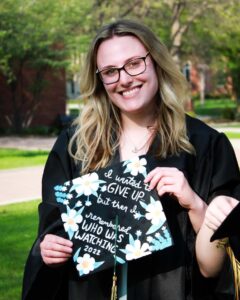
Sarah Schepp is a ‘22 graduate of St. Norbert College. During her time here, she majored in English, while minoring in Women & Gender Studies. She will be going onto graduate school at UW-Madison to study Library & Information Studies in hopes of becoming a librarian.